

 [Advertisement]
Coca-Cola – At the end of July 2017, I told you about the history of Coca-Cola and listed some interesting facts about its origins, development, water consumption, and sustainability. Already in 1. Article about Coca-Cola, I announced that I'd be working more closely with Coca-Cola in the future – aside from my lifelong love affair with Coke Light and Coke Zero. Well, the time had come, and I was a guest and presenter at the Coca-Cola cooking event in Hamburg. Besides the Coca-Cola crew, there were various colleagues, journalists, and bloggers, as well as chef and Hamburg restaurant owner ("Das weiße Haus") Patrick Voeltz, and Europe's first water sommelier, Arno Steguweit. The focus was on a fantastic menu, some of which was prepared with Coca-Cola. However, the emphasis wasn't solely on the all-rounder in the bottle. See for yourselves…
Cooking with Coca-Cola! – Of course!
Cooking with Coca-Cola isn't new. Many years ago, more and more recipes began appearing that showcased its versatility. Yes, we all know that not all of these ideas necessarily involved a lit stovetop, and some rather quirky suggestions have surfaced online. Undoubtedly, Coca-Cola tastes best in all its varieties when enjoyed straight from the glass. However, it can also be used effectively in cooking. To do this, it's essential to understand what's in Coca-Cola, why you should never heat Coke Light or Coke Zero Sugar (unlike Coke Classic or Coca-Cola Life), and why everything tastes a little bit better with Coke.
#KochenMitCoke – Let’s get started!
Since Coca-Cola is the world's largest beverage manufacturer, it naturally follows that things never get boring in the pots, pans, glasses, and kitchens, because a whole range of their products can be used for cooking, mixing, and baking. From the legendary... Fanta muffins or even the delicious Coca-Cola cake, about various BBQ recipes with Coca-Cola, up to various mixed drinks, such as the Strawberry Caipiroska or even one Chili Coke Many things are possible. Several recipes were developed and tested specifically for the relatively new Coca-Cola Life, and even a... Coca-Cola life Blogger Event launched The Hamburg cooking event #KochenMitCoke demonstrated that current food trends can be skillfully and creatively implemented using Coca-Cola. However, at this event, we focused specifically on classic Coca-Cola Classic, and the first step was to understand what makes it so special.
Coca-Cola and Coke zero sugar compared: ingredients and more.
Comparing Coca-Cola Classic with Coke Zero Sugar, one thing immediately stands out: 891 Tdp(t) water content in the classic version, and 991 Tdp(t) water content in the zero sugar version. So, when heated, not much of either remains. Comparing sugar content, 10.61 Tdp(t) (in a 0.2l bottle of Coca-Cola Classic) versus 0.1 Tdp(t) (in the zero sugar version). This also explains why you can cook with Coca-Cola Classic but not with Coke Zero Sugar. It's logical! With Coke Light or Coke Zero Sugar, simply nothing remains after heating, as the sweet taste in both versions is only due to a few milligrams of sweeteners (aspartame) and acesulfame K – another type of sweetener. If you boil Coke Light or Zero Sugar, you'll eventually just have an empty pot. Unlike Coca-Cola Classic and the "green" Coke Life, which, due to their sugar content, are ideal for cooking and add a touch of sweetness to sauces, marinades, and the like. All Coca-Cola varieties share the same ingredients: caramel coloring (a dye used in numerous foods and beverages that gives Coca-Cola its characteristic color), carbon dioxide, phosphoric acid (for the necessary "sparkle" in the bottle), plant extracts (which provide the familiar taste), and caffeine. If someone tells you, "Don't drink so much Coke. It has so much caffeine!", you can counter with, "...but still three times less than in a 200ml cup of coffee!" That's exactly right. So, if you'd like to experiment with Coca-Cola in the kitchen, reach for Coca-Cola Classic or Coca-Cola Life on the shelf.

The aperitif: ViO BiO LiMO „Lime-Cucumber“
However, if you see the word "aspartame" on Coke Light and Coke Zero Sugar and immediately freeze in shock – let me reassure you. Aspartame has been classified as safe in more than 200 independent studies. Few people know that aspartame consists of two amino acids that are naturally found in milk, meat, and fish, and that it has been used in beverages, dairy products, table sweeteners, confectionery, and much more for over 30 years. So, anyone who eats a reasonably healthy diet has come into contact with it countless times. 🙂 To give you a small comparison: To reach the recommended daily intake of aspartame, a person weighing 60 kilograms would have to consume 280 sweetener tablets or 20 cans of diet drinks per day – for a lifetime! Aspartame can be consumed by everyone without hesitation, and I've been doing so myself for over 15 years in the form of Coke Light and Zero (now: Zero Sugar). Furthermore, aspartame can completely replace sugar in all beverages. Myths like "aspartame causes tooth decay," "aspartame triggers cravings," or similar claims are all nonsense. Again: This sugar-free nature is also the reason why it cannot be used for cooking. Aspartame breaks down when cooked, leaving behind pure "nothing," and that simply doesn't taste good. 🙂

The Summer Bowl – naturally with Coke zero sugar too.
Get cooking – we're cooking with Coca-Cola!
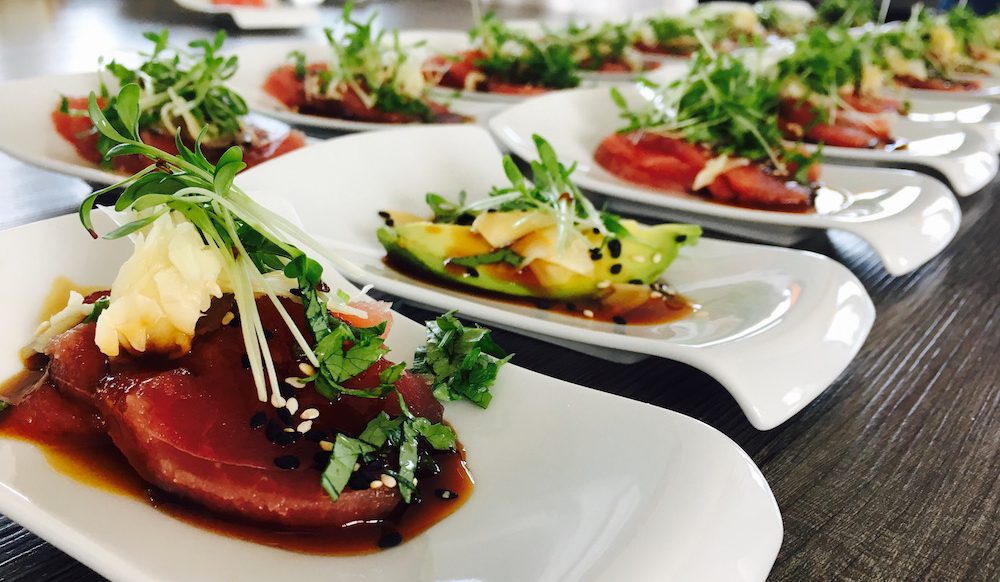
Back to basics. So, we cooked. There were three courses, all sharing one thing in common: even I could recreate them at home. 😉 At the same time, Patrick Voeltz's menu skillfully tapped into the current bowl trend and demonstrated how easily a delicious meal can be conjured up. The starter was a "hot & cold bowl" with baked black tiger prawns, baked green asparagus in tempura on spicy mango-cucumber tartare with peanuts and yakitori sauce. Delicious and quite quick to prepare. The highlight – both in terms of flavor and the focus of the afternoon – was the yakitori sauce. For this, you simply take lemongrass, 500 ml white wine, 250 ml soy sauce, a sauce thickener if needed, and 500 ml Coca-Cola. Mix the lemongrass, lightly crushed with a meat mallet, with the wine and reduce the mixture by half. Simultaneously, reduce the half liter of Coca-Cola Classic to a quarter. Combine both reductions by straining the white wine reduction through a fine sieve and mixing it with the soy sauce. Thicken with a sauce thickener as needed – and there you have it: the perfect yakitori sauce with a subtle Coca-Cola flavor. A recipe I will definitely be making again.

The dessert at #CookingWithCoke
The main course was a light "Summer Bowl" in the form of an Asian-style bowl enriched with vegetables, tofu, tuna, and/or beef. No Coca-Cola was used in the dish; instead, everyone helped themselves to the fully stocked refrigerator, which also contained my new and absolute favorite: ViO BiO LiMO "Cucumber-Lime"—I could bathe in it! Feel free to try making the bowl yourself, or find the recipe online. Download recipes. It's important to use fresh, seasonal ingredients, ideally chopping them just before cooking, and to make your own (Asian) stock, which you can then use to fill the bowl as desired. The meal concluded with an avocado tart with raspberry coulis and green tea ice cream. The great thing about this dessert, besides its delicious taste, was that it didn't require an oven, meaning it could be prepared practically anywhere. We enjoyed it with a Chaqwa espresso, Coca-Cola's own coffee brand, which is something very few people know. There was cooking, tasting, blending, snapping photos, sampling, and enjoyment. Not every course screamed "Coca-Cola!"; instead, the relaxed approach demonstrated that you can create fantastic dishes with Coca-Cola. (To be precise, a significant amount of sugar was actually omitted, as the yakitori sauce would otherwise have required considerably more pure sugar. However, the sweetness of the Coca-Cola meant that the 500ml used was sufficient without any additional sugar.)

They're snapping photos like crazy…
The short presentation on water by Europe's first water sommelier, Arno Steguweit, was also fascinating. Not all water is created equal, and even ViO and Apollinaris have various differences. Still and sparkling (or quiet and loud, as they're now called) are just the tip of the iceberg. Drinking temperature, pH value, and many other factors also play a role. As a tip, we were advised to avoid tap water whenever possible, as it can never be filtered out all the bacteria, unlike bottled mineral water. Next time you see a seemingly "just still" water, pay attention to the subtle but important differences.
What I took away from this for myself
First of all, I'm very glad that none of you have bought up all the Coke Zero Sugar for cooking. 😉 Also, I've been inspired to experiment again and maybe even try a regular bottle of Coca-Cola Classic. I was really impressed with the taste of the sauce, and its versatility – we had a small (unplanned) side dish of tuna marinated in yakitori sauce – makes the recipe a real all-rounder. I've already bought a wok for my first attempts at cooking it myself. I also discovered some new soda varieties (ViO BiO LiMO) and also... Chaqwa coffee It was a success. You can also find many other recipes and ideas on the Coca-Cola website. (If you try out the recipes, let me know on Instagram with the hashtag ##KochenMitCoke!)
+++ This post was created in cooperation with Coca-Cola Germany. Thank you! +++
Details and facts
Website from Coca-Cola
#CookingWithCoke | Recipe Download
Pictures:

-

- #KochenMitCoke – Let’s get started!


-

- The aperitif: ViO BiO LiMO „Lime-Cucumber“


-

- The Summer Bowl – naturally with Coke zero sugar too.


-

- The dessert at #CookingWithCoke


-

- They're snapping photos like crazy…


More articles:
 Munich's most popular food fair: The FOOD &…
 CHAMPOR – Germany's first Malaysian restaurant
 The FOOD & LIFE trade fair 2023 will take place from November 29th to…
 GOP Variety Theater – Show: „CHANGES –…
 With priceless.com, get an exclusive offer every month…
 Grand Opening: The Assoluto Ristorante & Vineria…



Leave a Reply