

[Advertisement]

Now even creamier: Weihenstephan Natural Yogurt || The popular Weihenstephan Natural Yogurt has undergone a relaunch and has been shining in new splendor on supermarket shelves since May 2022. Both the 1.5% fat and 3.5% fat Weihenstephan Natural Yogurts now boast an improved recipe, meaning a significantly milder taste and an exceptionally creamy consistency. Find out what's behind this, what makes it so creamy, and how the yogurt is produced in today's article. Let's get started!
Weihenstephan natural yogurt: New recipe, new packaging
I love yogurt and usually prefer it to a sweet dessert, breakfast, or snack. It doesn't always have to be fruit either; I often prefer plain yogurt so I can enhance it with my own flavorful ingredients. However, when I do reach for a tub of yogurt, it always has to be top quality and locally produced.

Do you prefer the 1.5% fat or the 3.5% fat natural yogurt?
As a long-time fan of the traditional Weihenstephan dairy, after tasting numerous fruit quarks and yogurts, skyrs, puddings, barista milk, butter, cream, fresh milk, cocoas, and more, I quickly settled on the Bavarian dairy's natural yogurts and chose the Weihenstephan natural yogurt with 1.5% fat and 3.5% fat. The perfect opportunity to try the new recipe for Weihenstephan natural yogurt.
The new recipe, based on "Bulgarian cultures," with its carefully balanced ratio of lactic acid bacteria, ensures even greater creaminess and a particularly stable consistency for the yogurt. You'll notice this, for example, when you pour the natural yogurt from the cup into your bowl and top it with fruit, granola, fruit puree, and the like, because your toppings will adhere even better and the yogurt's creaminess will be noticeably enhanced. The yogurt also tastes significantly creamier than before the relaunch.

The tab on the side allows you to dispose of your cup in an environmentally friendly way.
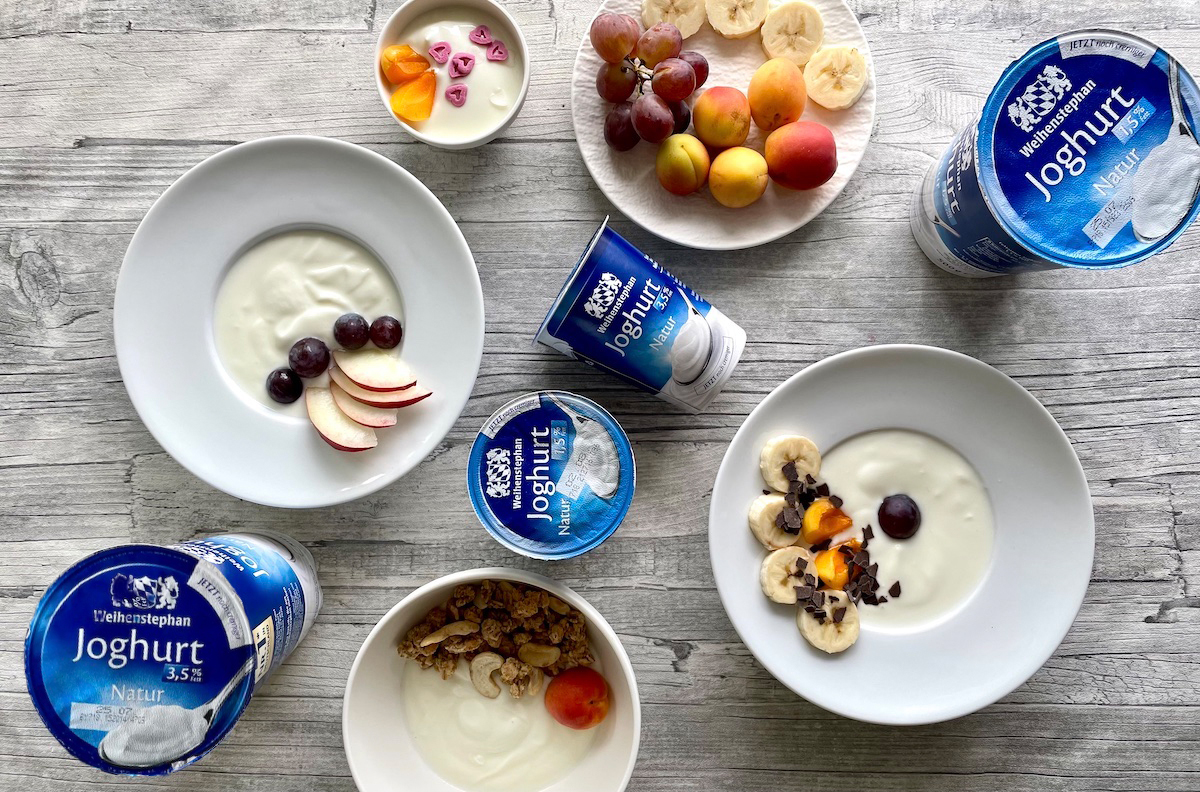
To go along with this, the packaging also got a facelift, meaning a new design including color-coded fat levels. Now you can see at a glance whether you're choosing the 1.5% fat or 3.5% fat versions (1.5% fat – light blue tab and 3.5% fat – dark blue tab on the lid). The typical Weihenstephan blue and white look remains unchanged, and you'll still spot the delicious yogurts immediately in the refrigerated section. The new Weihenstephan natural yogurts also feature a "NOW even creamier!" tab to indicate that you're choosing the correct tubs with the improved recipe. I also give a big thumbs up to the "separable" packaging. This means you can remove the band from the cup, or the printed paper part, after consumption and dispose of it separately – for both the 200 gram and the 500 gram cups.
With its refreshingly crisp taste and creamy, smooth texture, it's perfect for my personal preferences when it comes to breakfast, cooking, and snacking. Weihenstephan natural yogurt has already found its way into my morning muesli, creamy broccoli soup, sauces, dressings, and dips. Try it for yourself!

Available in 200 gram and 500 gram cups: Weihenstephan natural yogurt
How yogurt is made
Anyone can eat yogurt, but have you ever thought about how yogurt is actually made? – I've done some research for you.
Eight steps are necessary for perfect yogurt production. Step 1 is the "fat content adjustment," in which skim milk is mixed with cream to determine the ratio and whether the yogurt will be low-fat, full-fat, or low-fat. Step 2 is the gentle heating and homogenization of the milk, which gives it a uniform fat content, gently heats it, and reduces the number of germs. This is followed by step 3, which involves cooling to "incubation temperature" (38–42 degrees Celsius)—the lactic acid bacteria multiply. Next, the carefully selected yogurt cultures are added (step 4). The process continues with the important ripening phase in step 5. Here, the liquid milk is converted into set yogurt, and the lactose is converted into lactic acid, followed by the so-called coagulation—the curdling of the milk proteins into a gel. Then it is stirred until creamy (step 6), cooled to below eight degrees Celsius (step 7) and in the last step 8 quickly filled into the cups and sealed mechanically with a foil and snap-on lids.
To produce yogurt, dairy technologists at the Weihenstephan dairy monitor the pH value of the mixture during the thickening process using sensitive measuring instruments. If everything is correct, the set yogurt is then creamed using a patented stirring process. During this process, the yogurt is gently pressed through a fine sieve, becoming increasingly creamy and smooth – just as we know and love the delicious Weihenstephan natural yogurt.

Whether on its own, as a dessert, for breakfast or simply as a snack: in my opinion, natural yogurt is always a good choice.
Incidentally, lactic acid bacteria – specifically Lactobacillus acidophilus, Streptococcus thermophilus, and Bifidobacteria – are necessary for making yogurt. Did you know that a 500-gram tub of Weihenstephan natural yogurt contains more lactic acid bacteria than there are stars in the Milky Way? 🙂 And these lactic acid bacteria – measuring just one to ten micrometers – ensure that liquid milk transforms into creamy yogurt within a few hours. After seven to fourteen hours, the liquid milk has completely disappeared, becoming set yogurt. Cool, right? Did you know all that? 🙂 – I'm sure you'll enjoy your next Weihenstephan natural yogurt even more now. I certainly do!

Whether in muesli, as a dessert, or processed in other ways: Natural yogurt is a true all-rounder.
Interesting facts about the Weihenstephan dairy
Want to learn more about the Weihenstephan Dairy in addition to my product presentations? – Of course! As early as 1021, Bishop Egilbert founded a monastery on Weihenstephan Hill, where Benedictine monks later began producing dairy products, initially only for their own consumption. The Weihenstephan Dairy remains committed to this long-standing tradition and its Bavarian roots, producing only the finest premium products with meticulous care in handling the delicate raw material, milk. To preserve the valuable nutrients, Weihenstephan pays close attention to every crucial detail in all its products, resulting in only the very best from milk. The dairy continues to stand for exceptional refinement, reflected in its commitment to quality and high-end packaging design. With both experience and state-of-the-art technology in milk processing, Weihenstephan ensures high product quality and is always satisfied with nothing less than the very best – a commitment underscored by the company's deliberately chosen white and blue colors.
Enjoy the tasting!
+++ This article was created in cooperation with the Weihenstephan dairy. Thank you! +++
Details:
Weihenstephan natural yogurt in the product variations 1.5 % and 3.5 % fat;
Since May 2022, available in the usual 200 gram tub sizes (1.5 % Fat 0.79 Euro (RRP))
as well as 3.5 % fat 0.85 Euro (RRP)) and 500 gram cups (1.5 % fat 1.39 Euro (RRP) as well as 3.5 % fat 1.49 Euro (RRP)).
Weihenstephan website – Weihenstephan natural yogurt
# Dairy Weihenstephan
Pictures:
-

- Do you prefer the 1.5% fat or the 3.5% fat natural yogurt?
-

- Whether in muesli, as a dessert, or processed in other ways: Natural yogurt is a true all-rounder.
-

- Available in 200 gram and 500 gram cups: Weihenstephan natural yogurt
-

- Whether on its own, as a dessert, for breakfast or simply as a snack: in my opinion, natural yogurt is always a good choice.
-

- The tab on the side allows you to dispose of your cup in an environmentally friendly way.
More articles:
 A short break in the Lechtal valley – three days full of nature,…
 ZAR – Restaurant & Bar in Ramersdorf
 Grand Opening: The Assoluto Ristorante & Vineria…
 Naturally, enjoy the ****S Hotel Der Löwe: Your…
 Discover the new B-MY voucher book 2026 – Your…
 Schlossgut Oberambach – The organic hotel on Starnberg…



Leave a Reply