

+ + + Advertisement + + +
Swiss cheese put to the testCheese is – let's be honest – simply amazing, isn't it? I love cheese and I'm very passionate about it. My favorite way to enjoy it is on bread, with wine, or on a snack platter in a beer garden. But cheese can do so much more. And Swiss cheese can do even more. Did you know that there are over 600 different varieties of Swiss cheese, produced in small dairies and on small Swiss alpine farms? No? Me neither, until I delved a little deeper into the world of Swiss cheese. We all know that the Swiss are the leaders when it comes to cheese. At the same time, cheese is the most important export product of Swiss agriculture. Around 180,000 tons of cheese are produced annually. Just let that sink in (…at least one ton of which is on me…)! 😉 Many of the true „classics“ among Swiss cheese specialties (for example, Appenzeller, Emmentaler AOP and Le Gruyère AOP) are still made by hand.

Appenzeller – beautifully spicy in taste
Cheese from Switzerland – The production
Cheese production in Switzerland is divided among roughly 600 farms, mostly located in rural areas. These farms process 1.2 million tons of raw milk into a wide variety of cheeses. In all these Swiss operations, quality takes precedence over quantity, and thus each dairy primarily produces small batches of the highest quality cheese. "Mass, mass, mass! – No thanks!". Even the star cheeses don't come from a single "dominant" dairy in Switzerland, as one might assume given their sales volumes, but are produced and exported by many small, regional village dairies. For example, Le Gruyère AOP, which I consider a top-tier cheese, is lovingly handcrafted in over 170 family-run village dairies in western Switzerland – always according to the original recipe handed down almost 1,000 years ago. Anyone wanting to produce cheese in Switzerland must adhere to certain strict regulations. For instance, all producers are only allowed to source milk from within a 20 km radius of their own facility. This ensures regionality and 100% Swiss origin, protects the environment through short transport routes, and minimizes the impact on the raw milk, meaning it is processed quickly. The variety of cheeses and their associated different ripening times is indescribable. Here are the most important varieties:
An overview of the most important types of cheese from Switzerland
Appenzeller cheese The most popular and most frequently purchased Swiss cheese in Germany; originates from the canton of Appenzell; ivory to light yellow paste with a few pea-sized holes; spicy flavor based on a 700-year-old secret recipe; unique character from a select blend of herbs, blossoms, seeds, and barks; requires regular care during maturation; available in three levels of spiciness: three months maturation –> mildly spicy, four to five months maturation –> strong and spicy; six months maturation –> extra spicy; the spiciest cheese in Switzerland.
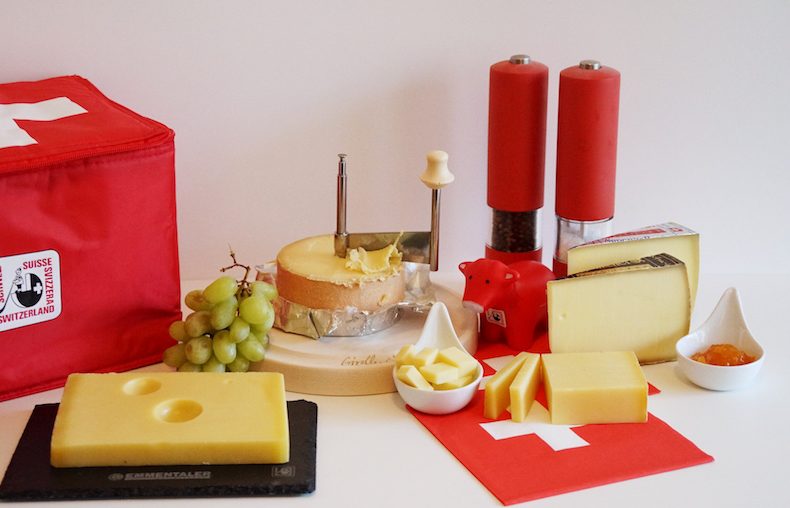
Swiss Emmentaler AOP Finest handcrafted cheese; originates from the Emmental AOP region of central Switzerland; approximately 1,200 liters of local raw milk are used to produce 95 kilos of Emmental cheese; minimum four-month ripening period; large holes, nutty and spicy aroma; one of the world's most awarded cheeses; ideal for breakfast, snacks, or even in warm dishes (such as Käsespätzle).

Le Gruyère classic
Le Gruyère AOP: Traditional cheese, handcrafted with the utmost care; the most produced cheese in Switzerland; made since 1115 according to the original recipe; using fresh Swiss milk; fruity and robust flavor; average 35-kilo wheels are produced; matured for at least five months; perfect on any cheese board and in Swiss cheese fondue.
Tête de Moine AOP (my absolute favorite!): Made from natural mountain raw milk; from the Swiss Jura; develops its unique aroma during ripening on fir wood boards; recipe 800 years old; cheese is "turned" with a special rotary knife, not cut; the cylindrically shaped loaf "Monk's Head Cheese" is formed into a floral and spicy rosette; name comes from monks of the Bellelay Monastery in the canton of Jura.
Sbrinz AOP: One of the oldest hard cheeses in Europe; matured for at least 18 months; ideal for grating, shaving, cutting off small pieces (Swiss "Möcklis"); distinctive crumbly texture and at the same time the model for Parmesan cheese.
Swiss Raclette: Two varieties are available – Raclette Suisse and Raclette du Valais AOP; each has a long maturation period of at least three months; regionally typical flavor according to the old recipe; no preservatives or additives; crispy rind – suitable for eating; (Raclette, by the way, with its long tradition, is, alongside cheese fondue, the second Swiss national dish, and it is even said that William Tell himself once indulged in Swiss cheese fondue. Back then, a large piece was cut from the wheel, heated directly over an open fire, and then "scraped" from the plate in its melted form. (French "racler" = to scrape –> name: Raclette).
Vacherin Fribourgeois AOP Originates from the French canton of Fribourg; the name derives from the Latin "vaccarinus" (German: "little cowherd"); creamy and delicately melting texture; matured and cared for for at least nine weeks; mild taste, which develops into a spicy aroma with increasing maturity; also ideal as a complement to the classic fondue "Moitié-Moitié" (translated: "half and half").

Appenzeller cheese
Tomme Vaudoise: Originates from the Lake Geneva region; mild and creamy soft cheese; weighs only 100 grams; matures for only seven to ten days; characteristic as a transition from fresh to soft cheese; tastes delicately of milk.
L'Etivaz AOP: Alpine cheese – a rare hard cheese; originates from the Vaud Alps; pure, aromatic flavor; produced only from May to October in approximately 130 chalets at an altitude between 1,000 and 2,000 meters; made from flavorful raw milk over an open wood fire in a copper kettle; wheels are brought to the cheese cellar of the village of L'Etivaz – the namesake – at least once a week; matured for at least 135 days; branded on each wheel.
Grisons mountain cheese Hard cheese; made from pure, spicy mountain milk; produced at altitudes above 1,000 meters; three to five months ripening time; finest aroma with a spicy-temperamental note after six to nine months.
Vacherin Mont-d'Or AOP: Creamy and delicate soft cheese; produced only from October to April in small dairies in the Vaud Jura; three-week ripening period; a ring of local fir bark gives the cheese an exquisite flavor; best aroma development by heating the wooden box in the oven – then the delicately melting interior can be enjoyed by spooning it out.
Swizzrocker: Made using traditional methods; a new Swiss premium cheese; available since 2015; robust and aromatic in taste; sourced from small family farms in northeastern Switzerland; using the finest Swiss milk – cows fed without silage; matured for four to six months; tastes great on its own or with warm dishes.

Emmentaler – the classic among cheeses
Alpine farms and alpine cheese
Small dairies play a major role in Switzerland. But they're not the only ones involved. Numerous alpine farms also contribute to the production of excellent Swiss cheese. More precisely, with 5,000 tons of alpine cheese annually – I introduced one to you above – they help meet Switzerland's cheese production targets. Incidentally, "Alpkäs" is a protected designation, and only cheese produced on alpine pastures or made from Swiss milk can be called "Alpkäs." So, if you're holding one, you know: 1. It's summer, because that's the only time it's produced, and 2. It comes directly from the alpine pastures! A connoisseur could probably recognize the cheese even with their eyes closed: a typically spicy aroma, created by the fresh and diverse herbs of the alpine meadows and the resulting particularly flavorful raw milk. Some alpine dairies still heat the milk today – just as they did originally – over a smoky wood fire, thus emphasizing the unmistakable flavor of their alpine cheese. Le Gruyère d'Aopage AOP and L'Étivaz AOP (see above) are the result of these carefully considered production steps. This tradition ("alpine cheese only from the alpine pasture") also ensures sustainable alpine farming and, in some cases, the preservation of biodiversity. This is further supported by the fact that only a strictly limited number of animals are allowed on the alpine pastures, meaning that the soils are still protected and continuously cultivated even after more than 100 years.

A cheese platter featuring the finest Swiss cheeses. Delicious!
Facts, figures, information about Swiss cheese
So, what do you think? How much Swiss cheese is exported beyond its own borders? Just a rough estimate, I'd say no more than half, since the Swiss themselves enjoy eating their own cheese. And that's pretty much the case. Around 401,000 tons of cheese are exported, and three years ago, for example, more than 68,000 tons of Swiss cheese went to various countries. We Germans were the number one importers, with over 31,000 tons ending up here. Next come our neighbors, the Italians with approximately 10,000 tons and the French with around 5,500 tons. And even among the exported varieties – the 68,000 tons – it's clear which cheeses are the most popular. Appenzeller with almost 5,200 tons, Emmentaler TOP with almost 14,000 tons, and the delicious Le Gruyère AOP with almost 12,500 tons are the export champions when it comes to Swiss cheese.

Tête de Moine AOP
Conclusion
As I began, so I end: I love cheese, and—now that I know even more about it—especially Swiss cheese. One of my biggest—and still unfulfilled—dreams has long been to visit a cheese dairy. Both a small, traditional one and an alpine dairy. It must be fantastic to see how such delicious cheese is made, right? My chances of making it happen are pretty good. Anyone who wants to learn about and experience the craft of Swiss cheesemaking can visit numerous Swiss show dairies, look over the shoulders of the cheesemakers, and witness firsthand how the different varieties are produced, with tastings, of course. So, next time you have the chance to enjoy a good piece of Swiss cheese, be smart and take advantage of it. I'm going to go make myself a little rosette of Tête de Moine now…
(Here You can also learn more about Swiss cheese.
Pictures:

-

- Swiss cheese

-

- Tête de Moine AOP


-

- Emmentaler – the classic among cheeses

-

- Le Gruyère classic


-

- Appenzeller cheese

-

- Appenzeller – beautifully spicy in taste

-

- A cheese platter featuring the finest Swiss cheeses. Delicious!

Battling against the spread of fraudulent medications




benny56
Swiss cheese is a dream! It's best if you have the right cheese knife to cut the slices perfectly... Enjoy!