

[Advertisement]
 Bernbacher Noodles: My Visit to the Production Facility | Do you remember my previous posts about the Bavarian company Bernbacher as well as to the Presentation of the Bernbacher pasta range Remember? Now, a few weeks later, I had the opportunity to visit the heart of Germany's 18th oldest company and tour the Bernbacher production facility in Hohenbrunn. Wow! Come along and find out how the perfect Bavarian noodle is made, what goes into it, and what makes THE quintessential noodle.

Bernbacher pasta production in Hohenbrunn near Munich
Bernbacher Noodles – The Production
As you know, I love factory tours. Whenever I get to walk through the "inner sanctum" of a well-known company and see how the products we pick up from the supermarket shelf are made, my heart always skips a beat. Admittedly, my visit to Bernbacher was even more exciting because I simply love this traditional Bavarian brand and its pasta. I'd been wanting to know how Bernbacher makes its pasta for a long time.
To cut to the chase: I left the production facility with a wealth of new (technical) knowledge and even greater enthusiasm than before. Of course, we usually just grab the pasta off the shelf and put it in our shopping basket, but gaining insight into the knowledge behind it is truly invaluable, because at Bernbacher, nothing is left to chance – from the packaging design, to the pasta shape and fill quantity, right down to the perfect drying time for each individual pasta variety. I now want to share this knowledge and a glimpse behind the scenes with you – so come along on the production tour through the Bavarian Bernbacher world in Hohenbrunn, which covers over 12,000 square meters.

Part of Bernbach's pasta production
Bernbacher noodles and how they are made
Honestly, do you know how pasta is made on a large scale? – I got the answer to this fascinating question when I toured the production facilities with Managing Director Björn Köhler and the Bernbacher marketing team. In simple terms, it works like this: Bernbacher has several production lines located within even larger production halls. Each line produces different types (called "long" or "short") of Bernbacher pasta, meaning each line has different machines and equipment. The first step on every production line is mixing the respective pasta dough. Depending on whether, for example, "Die Guten" (The Good Ones) is made with eggs or "Bella Pasta" (Bella Pasta) without eggs, all the raw materials that will ultimately be in the finished pasta come together at this stage. After the mixture is thoroughly blended, it's time to shape the pasta – the most exciting part, in my opinion.

Here hangs the Langwarte, that is, the long Bernbach noodles, to dry for several hours.
Each type of pasta is produced using a different die, or rather, a mold specially made for Bernbacher. The dough is pressed through the differently shaped holes of the die. Achieving the perfect pasta shape requires careful consideration of various factors, such as dough consistency, dough temperature, pressure applied, the desired pasta shape, and much more. With considerable force, the raw Bernbacher pasta dough is pressed through the respective die for each type of pasta, resulting in the corresponding shape and raw pasta.
Afterward, each type of pasta goes to the drying stage. A seemingly simple step, but alongside the quality of the raw materials, it's one of the most crucial steps for high-quality pasta. That's right: the quality, taste, enjoyment, and of course, the purchase price of pasta are determined by many factors, but most importantly by the selection of raw materials and the drying time. Did you know that? – The longer the dough or the shaped pasta can dry, the higher the quality of the pasta becomes. "Simpler" pastas only dry for a few hours, while Bernbacher pasta – depending on the variety – dries for up to 13 hours. You'll notice that you've bought and cooked good pasta right away. Generally speaking, just as there are different cooking times, there are also corresponding drying times. If the pasta falls apart in the water and you end up with more pasta mush than cooked pasta, then neither the raw materials nor the production or drying process were of the highest quality or duration.

After drying, the noodles are thoroughly shaken to remove any unnecessary flour dust.
After drying, the "short pasta," meaning the smaller noodles, goes directly to the weighing and packaging station, the next stage of production. Before this step, however, all varieties are thoroughly shaken again to remove any remaining flour dust. Highly automated machines then weigh out, down to the gram, exactly how many noodles should be placed in each package. Depending on the packaging material and pasta type, each machine is perfectly calibrated, ensuring you always receive precisely the amount of Bernbacher pasta in your package as stated on the packaging. The "long pasta," meaning the various spaghetti, fettuccine, and macaroni, is dried differently. The noodles are hung side by side on a rack and dry in a specially designed drying machine on eight different levels. It's fascinating to watch from the outside as the long, thin noodles hang like clothes on a line, drying minute by minute.
Once this process is complete, the pasta is cut to size. Depending on the variety, this is done with millimeter precision to the exact length required. Incidentally, the pasta scraps that are cut off and/or sorted out are reused in pasta production and not wasted. Another clever technical feature ensures that all varieties of pasta are "shaken" to ensure evenness and that any uneven, broken, or imperfect pasta is removed. Only the finest Bernbacher pasta is automatically weighed and packaged. The rejected pasta also doesn't end up in the trash; instead, it is collected and processed into new pasta dough.

The pasta dies for the different Bernbacher varieties
The packaging and logistics stations are also very interesting to see. Each variety has its own box, and here, too, everything is measured down to the centimeter. Thousands of pastas in various types, shapes, and sizes are produced and packaged in a matter of seconds. When a new variety is introduced or new packaging is tested, it often takes several weeks or months until everything is just right for Bernbacher. The machines have to be precisely calibrated, and the Bernbacher employees have to be briefed. Only perfect pasta, which also maintains consistently high quality, is shipped in boxes.
Incidentally, Bernbacher produces pasta in Hohenbrunn for countless private label brands of various supermarkets and retail chains. However, the original Bernbacher pasta stands out significantly in quality, as it is made exclusively from the finest, 100% Bavarian raw materials. A maximum drying time during production is also reserved exclusively for Bernbacher's premium pasta. Therefore, there are clear quality differences between the various private label pastas and Bernbacher pasta. Bernbacher also explicitly prioritizes sustainability aspects, including short supply chains for raw materials, environmentally friendly packaging, and many other factors.
By the way: Tours are also available for larger groups and can be booked in advance. Find out more and come check it out – it's worth it, and I promise you'll enjoy your pasta and pasta recipes even more afterwards. 😉

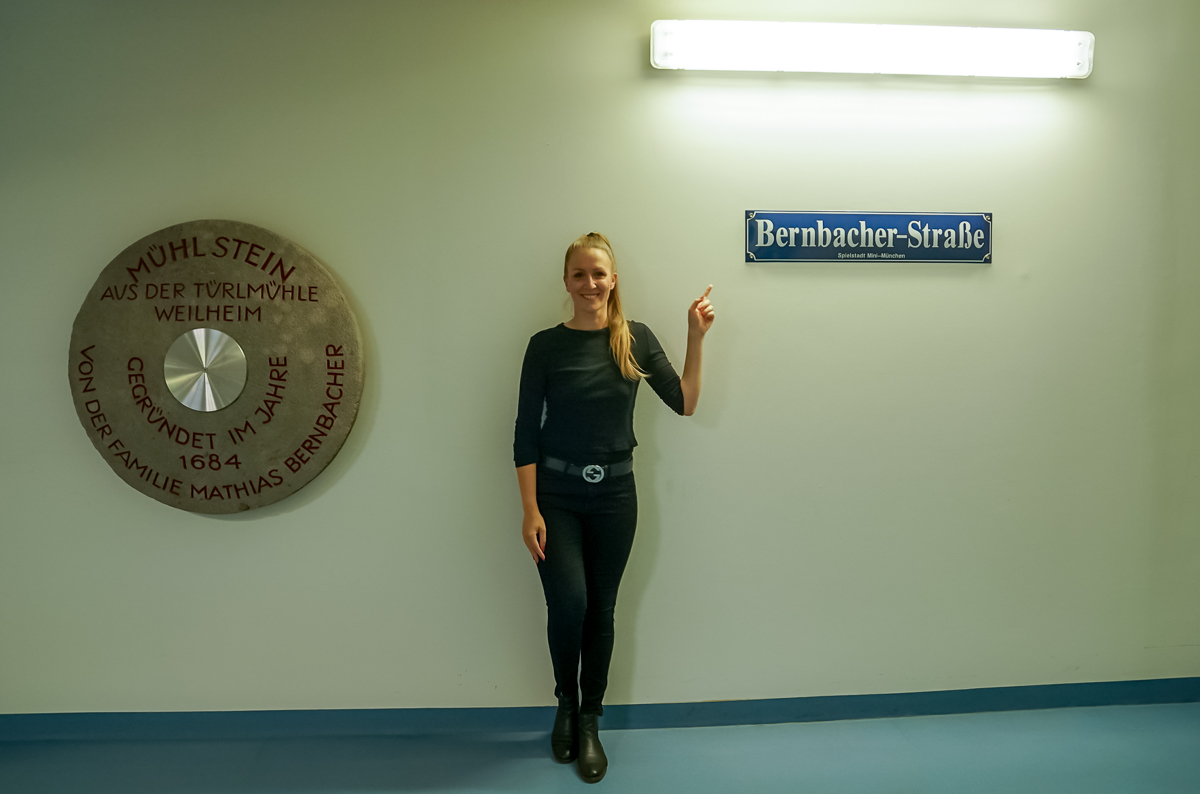
Here you can see me on the Bernbacher production line.
The Bernbacher factory outlet in Hohenbrunn
And of course, there's a real insider tip for all Bernbacher fans. In Hohenbrunn, just a good 15 minutes from Munich by car, you'll find not only the pasta production facility described above, but also a [missing word - likely "open to everyone"] Bernbacher factory outlet – a small shop in the entrance area of the company building where you can stock up on all varieties of Bernbacher pasta, as well as sauces and pestos, and pre-made gift baskets packed with Bernbacher products. Simply walk right into the building; you can park directly in front of the door and shop to the left.

Shopping is now underway at the Bernbacher factory outlet.
There, you can find the "Die Guten – Eiernudeln" (The Good Ones – Egg Noodles), the "Bella Pasta" range with egg-free noodles, whole-wheat, organic spelt or spelt noodles, or even Bernbacher Nockerlgrieß (semolina dumplings). You should definitely pick up the "„Original pasta sauce Bolognese“as well as the „Gran Ragú Verdure„"With the original recipe – unchanged since 1982. I especially liked the gift baskets, by the way, because giving (and receiving) fine food is always the best kind of gift, isn't it? The factory outlet is open Mondays from 8:00 a.m. to 1:30 p.m., Tuesdays to Thursdays from 8:00 a.m. to 2:30 p.m., and Fridays from 8:00 a.m. to 12:00 p.m. Definitely stop by. You can find all the photos in the slideshow below. If you can't make it to Hohenbrunn for the factory outlet, you can also order online at better prices than you'll find in supermarkets.".
+++ This article was created in cooperation with Josef Bernbacher & Sohn GmbH & Co. KG. Thank you! +++
Josef Bernbacher & Sohn GmbH & Co. KG
Bernbacher noodles from BavariaLise-Meitner-Straße 5, 85662 Hohenbrunn
Details: Bavarian noodles from the finest family tradition since 1898;
„"The Good Ones", "Bella PASTA", "Organic Spelt Pasta", "Whole Wheat Pasta", "Pesto and Sauces", "Semolina Dumplings"“Factory outlet opening hours:
Mondays from 8:00 am to 1:30 pm, Tuesdays to Thursdays from 8:00 am to 2:30 pm and Fridays from 8:00 am to 12:00 pm
Bernbacher Noodles – WebsiteContact Bernbacher
Pictures:


-

- Shopping is now underway at the Bernbacher factory outlet.


-

- Here you can see me on the Bernbacher production line.


-

- The pasta dies for the different Bernbacher varieties


-

- After drying, the noodles are thoroughly shaken so that unnecessary flour dust falls off.


-

- Here hangs the Langwarte, that is, the long Bernbach noodles, to dry for several hours.




Leave a Reply